
Jeanne Dielman: The Queen of Quarantine
The year is 2020, the writer is me, the time is quarantine, and the class I am in requires me to watch an almost four-hour long, obscure, cult-classic, “feminist,” film (but we’ll get into that), a Criterion Classic, entitled: Jeanne Dielman, 23 Commerce Quay, 1080 Brussels. Apparently, most scholars view this as a feminist film, but after watching the film, I was positively awestruck by how voyeuristic I felt, watching this woman do her menial tasks. Perhaps that I had just completed working on a project on Laura Mulvey’s Visual Pleasure and Narrative Cinema, but all I could think of was the forced voyeurism of watching this woman untangle; not knowing when she would have wanted cameras to see her, and when she would not have wanted cameras to see her. I could not stop thinking about the intimate moments I felt that I was spying on, and more acutely, how shockingly familiar it felt watching Jeanne Dielman’s mental state unravel in juxtaposition to watching that of a woman’s, (or more personally, myself, in 2020, in quarantine) mental state unraveling.
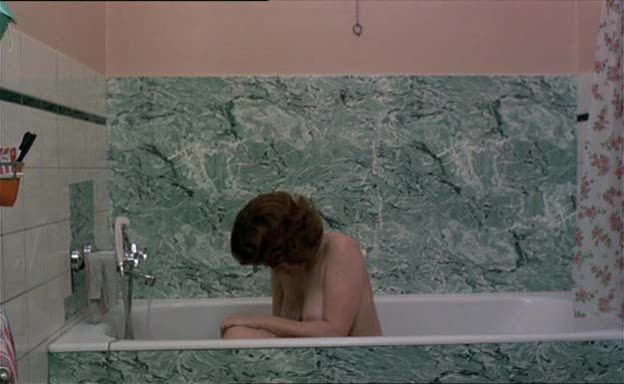
The formatting of the film, the three days, also lends itself to the “quarantine breakdown,” many have been experiencing. Many have joked about the fact that “people are going so crazy that they’re shaving their heads,” but the amount of mental illness that can be created by forcing one to be alone and/or to be stuck inside is no laughing matter. Jeanne Dielman spends most of her time alone and most of her time inside. The first day could be likened to the start of this virus, (and this argument, is of course, for those of us fortunate/privileged enough to be in safe places): trying to be clean, trying to work out, trying to take care of ourselves, trying to get dressed every day, trying to cook. The second day is the reality of the madness: when the cabin fever sets in, things start breaking, arguments happen, and emotionally, I personally, and Jeanne, began/begin to break down. The third day is the catastrophe: the mess that this has made of all of us, the untidiness, the forgetfulness, and the thing that shocks us it out of it all: the murder. In my case, I really hope that my quarantine does not end in murder, however, I feel as though I can relate to her breakdown. I’m trapped in my cell, and she’s certainly trapped in hers. My cell being my one-bedroom apartment alone during quarantine; her cell being her life, the patriarchy, how she makes money, and the menial tasks that encompass her.
That being said, I cannot see this film as a feminist film. Felicia Elliott notes in an article on The Cinessetial, “Director Chantal Akerman said in a 2009 interview, ‘…if I did the film now I don’t know that it would be called feminist. It could have been done about a man, too.’” It may have been feminist in the 70s to spend time watching women do rigid tasks, repeatedly, but now, in my opinion, it just seems to be a relic of feminism of the past. I hope that now, in the 4th wave of feminism, we can acknowledge that this film is an artifact of a certain time and a piece of history, but no longer necessarily feminist. Watching Jeanne be stuck in such a traditionally feminine role, is not overtly empowering. She’s not a feminist icon, she’s an oppressed human, both sexually and verbally. She clearly has trauma that she passes to her son.

This is clear in the way that she and her son communicate. There is no healthy communication between them. They barely greet each other and appear to be opposites; where she is womanly, petite, and immaculately groomed, he is boyish, very tall, and messy. They are extremely awkward around one another, and although he seems older than a teenager, it’s very challenging to tell exactly how old he is. They act bizarrely towards each other, with her sparing no details from her sister’s letter, including the parts where her sister describes how badly she feels for her that she is all alone; and because she does not comment on her decision to be alone, unless pressed, her son has no conception of sex or love. The exchange in which her son explains that if he was a woman, he would want to have sex with anyone who wanted to have sex with him, being answered with her, “How would you know? You’re not a woman,” seems to me, almost just “seemingly” feminist. She tries to teach him the bare minimum of the male gaze but still keeps both him and herself in the dark, both figuratively and literally.

She spends the whole film turning the lights off. Jeanne Dielman lives in a purposely dark world. She is turning the lights off on her life, her opportunities, and her sexuality. Everything is oppressed. Her son, in contrast, is always turning the lights on. The only people asking Jeanne questions are in the light – her son and the woman she babysits for. Everyone else is silent or in the dark. I imagine that she has spent most of her life, and of course, specifically in this film, examining herself in the mirror. In both the opening of the film and the end – before she kills the John that makes her climax – she stares at herself in the mirror. In Jean Kilbourne’s Killing Us Softly: Advertising’s Image of Women, Kilbourne explains how advertisements lead women to think about their bodies as individual items. Staring at oneself in the mirror, accessing these items, adds to that. She explains in her lecture:
We spend so much time watching Jeanne Dielman put together every part of her being. The hair, scrubbing herself clean in the shower, how she dresses – how she quite literally turns herself into a machine, an item – instead of a human. She is a few parts of a woman, but not a whole human. It is clear how important looks are to her. Everything must be perfect. When her son comes in during the second day, when she is beginning to fall apart, the first thing he says to her (which in my opinion, is blatantly both rude and strange), is “your hair is a mess.” He doesn’t ask her if she is okay or how she is, but simply puts her down because of her appearance. Even as she is unraveling, she is wearing high heels. It all leads me to question – for a feminist film, why is it all so repressed? If she is as connected to her sexuality as she must be, why is her son so seemingly infantile when it comes to sex? His friend Yan is clearly aware of his sexual awakening, and yet, Sylvain is so sexually withdrawn.
Ivone Margulies writes for The Criterion Collection:
“Never casual, each of the film’s uniquely strange and long-winded monologues expresses some form of gendered pressure: they refer to Jeanne’s marriage, the son’s Oedipal thoughts, each breathing a sexual anxiety, each a drawn-out, wordy attempt to mitigate the ‘other scene’ we never see, the elided afternoon trysts.“
Her son has Oedipal thoughts about her, which is, honestly, frightening. Is that what is happening to people in Quarantine? I hope not. Why is he so sexually scarred that the thought of his parents having sex disgusted him? What had traumatized him; or – who? Is her need to comply with the order, as Margulies writes, actually “obsessive-compulsive?” Her desire to be perfect – is that a woman’s repression or actual mental illness?

In our class we spoke a lot about how feminists are split on the matter of sex work and I can’t say that I see this film as pro-sex work at all. Even though her job is to be completely sexual, she is at the hands of the patriarchy and her repression. Sex isn’t “sexy” – it’s a chore. In this household, it’s a job. It’s not anything for Sylvan to want or desire, it’s something that he literally needs to protect his mother from. Who would be considered the “evil” in this film? The sex work? The societal standards? The men? The patriarchy? All of the above? I personally am not a fan of sexwork, as I find that it contributes to the patriarchy. I know that my professor, Ian Barnard, feels very differently. In this film, however, I really only see the negative involve in Jeanne working in the sex industry. Honestly – why is she even a sex worker? Does she get pleasure out of it? Jeanne doesn’t seem to get a lot of pleasure out of anything. Why doesn’t she make money as a clerk at the grocery counter or a seamstress or by doing a million other (feminine) jobs she could have done during the 60s/70s? Why does she choose sex work?
I am sad for Jeanne. I am sad that being both so repressed and oppressed leads her to her fatal end. It’s sad that she felt as though she needed to kill a man to conquer the mess that was beginning to become her life that was falling apart. Her life revolves around the men she serves. In fact – the film barely passes the Bechdel test. On the Bechdel Test’s website they note that it barely passes the test, as to pass the test, it must: “1. It has to have at least two [named] women in it, 2. Who talk to each other, 3. About something besides a man.” There is Jeanne and the child’s mother (who DOES NOT have a name), and they do talk to each other, about groceries – but it’s short and sudden. Even though it may be historically “feminist,” I personally do not see this as a feminist film; additionally, I do believe that it is easy to juxtapose Jeanne’s mental breakdown with the mental breakdowns many are suffering from/are having currently due to COVID-19.
Works Cited
Davidson, Alex. “Chantal Akerman for Beginners.” British Film Institute, 1 Apr. 2016, http://www.bfi.org.uk/news-opinion/news-bfi/features/chantal-akerman-beginners.
Donadio, Rachel. “The Director’s Director: Chantal Akerman.” The New York Times, The New York Times, 25 Mar. 2016, http://www.nytimes.com/2016/03/27/movies/the-directors-director-chantal-akerman.html.
Elliott, Felicia. “Messy, Complicated Feminism.” The Cinessential, 9 May 2017, http://www.thecinessential.com/jeanne-dielman/feminism.
Lim, Dennis. “Then as Now, the Terrors of the Routine.” The New York Times, 18 Jan. 2009, archive.nytimes.com/www.nytimes.com/2009/01/18/movies/18lim.html.
Margulies, Ivone. “A Matter of Time: Jeanne Dielman, 23, Quai Du Commerce,1080 Bruxelles.” The Criterion Collection, 17 Aug. 2009, http://www.criterion.com/current/posts/1215-a-matter-of-time-jeanne-dielman-23-quai-du-commerce-1080-bruxelles.
Meckler, Jeremy. “U Of M Students Respond to ‘Jeanne Dielman, 23 Quai Du Commerce, 1080 Bruxelles.’” Walker Art Center, 15 Nov. 2011, walkerart.org/magazine/u-of-m-students-respond-to-jeanne-dielman-23-quai-du-commerce-1080-bruxelles.
Mulvey, Laura. “Visual Pleasure and Narrative Cinema.” Screen, vol. 16, no. 3, 1975, pp. 6–18., doi:10.1093/screen/16.3.6.
Mwic. “Bechdel Test Movie List.” Jeanne Dielman, 23 Quai Du Commerce, 1080 Bruxelles – Bechdel Test Movie List, Creative Comments, 19 June 2012, 14:14:58., bechdeltest.com/view/3368/jeanne_dielman,_23_quai_du_commerce,_1080_bruxelles/.
 Maddie's Blog for Film, Gender, Sexuality Class